
Categories
Blog

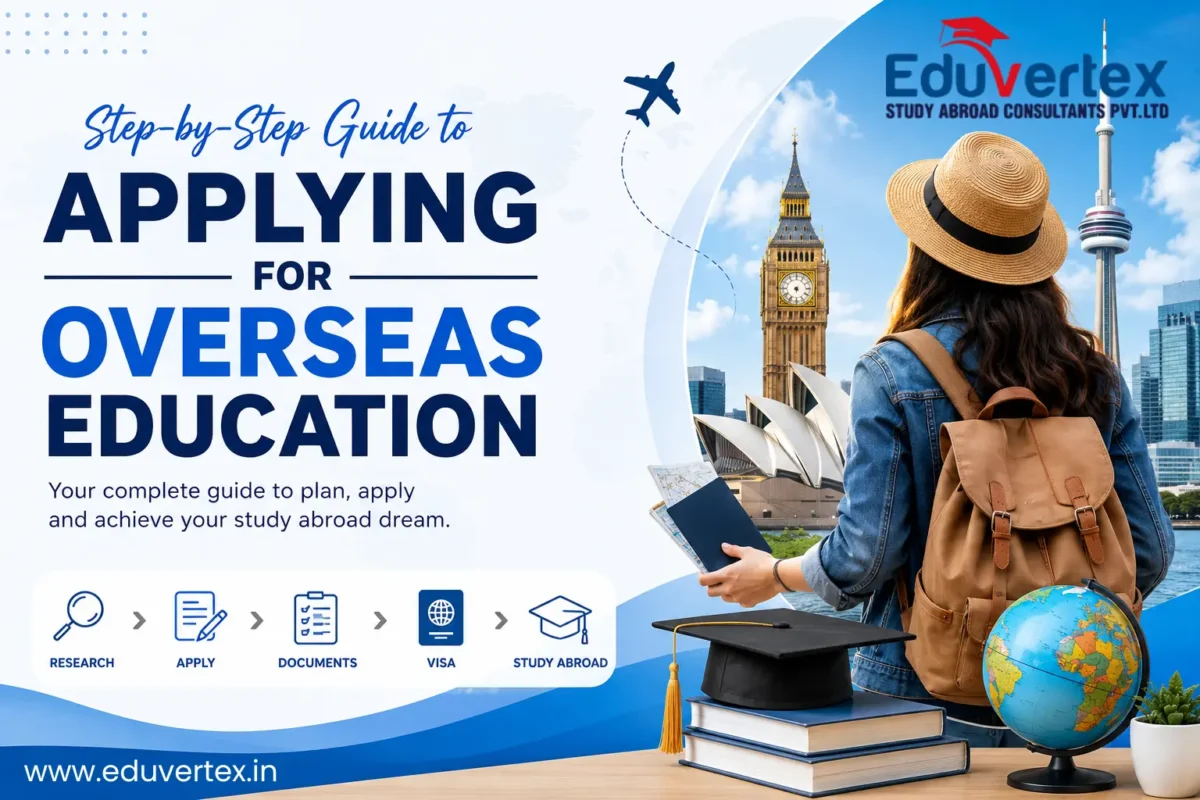
How to Apply for Overseas Education: A Complete Step-by-Step Guide (2026–27)

Applying for overseas education is one of the most significant decisions a student makes — and also one of the most process-heavy. Between choosing the right country, meeting English test cutoffs, preparing your Statement of Purpose, submitting applications, and finally securing a student visa, there are dozens of moving parts that need to come together at the right time.

The good news: when you understand the full process in advance, it is entirely manageable. Every year, students from small towns in Kerala and across India successfully navigate this journey and enrol in world-class universities. The following guide talks you through precisely – step by step, with the unique information that standard instructions leave out.

Many students also seek support from trusted overseas education consultants like Eduvertex to better understand university admissions, visa procedures, and scholarship opportunities.

Why Choose Overseas Education?

International education has become more accessible — and more competitive — than ever for Indian students. Beyond the obvious benefit of a globally recognised degree, there are practical, career-shaping reasons to study abroad.

  • Post-study work opportunities are one of the most searched topics among Indian applicants right now, and rightly so. Canada grants a Post-Graduation Work Permit (PGWP) of maximum 3 years. The UK’s Graduate Route allows 2 years of open work rights. Australia’s graduate visa (subclass 485) grants 2–6 years depending on your study location and field. These pathways turn an international degree into a direct immigration route — something a domestic degree cannot offer.
  • Tuition-free education in Germany is worth its own mention. Public universities in Germany charge only a semester contribution fee (typically €150–400 per semester) rather than full tuition, making it one of the most cost-effective study destinations in the world for English and German-taught programmes.
  • Research and innovation exposure at universities ranked in the global top 100 gives students access to labs, industry partnerships, and faculty that simply do not exist at most Indian institutions in niche fields like AI, biomedical engineering, or renewable energy.

Students who are confused about selecting the right country or course often prefer guidance from experienced study abroad consultants such as Eduvertex to simplify the decision-making process.

Step 1: Research From the beginning and Create Your Timeline 

Start your research at least 12–18 months before your target intake. This is the single most important piece of advice, and the one most students ignore until it is too late.

Listed below is what that timeline appears to be in practice:

If you are targeting the September 2027 intake (the most common entry point for Canada, UK, Australia, and the USA), your planning should begin no later than October 2026. By January 2027, your English test should be complete. By February–March 2027, your applications should be submitted. By May 2027, you should have your offer letter and be preparing visa documents.

Missing this rhythm — typically by starting in January for a September intake — means you are rushing your SOP, missing early-round deadlines, and applying for a visa with 4–6 weeks of buffer instead of the recommended 12–16 weeks.

Core things to research in your first month:
  • Country immigration climate: Visa approval rates for Indian students have shifted meaningfully. Canada tightened its student permit policies in 2024 and introduced a cap on study permits. Australia raised its English score requirements. Check the latest government advisories, not blog posts from 2022.
  • Post-study work pathways: Does the course and institution type qualify you for a post-graduation work permit? In Canada, only Designated Learning Institutions (DLIs) qualify. In the UK, your university must be a licensed Student sponsor.
  • Cost of living vs. tuition: Germany has low tuition but €800–1,100/month living costs. Canada runs CAD 15,000–20,000/year in living expenses outside tuition. New Zealand is often overlooked but more affordable than Australia.
  • Intake availability: Not all countries offer three intakes. Germany’s major intakes are October and April. Canada and Australia offer three intakes but the prime one is September/February respectively.

Use this research phase to narrow your list to two or three countries before you start shortlisting universities.


Step 2: Choose the Right Course and University 

The right course is not the most famous one — it is the one that leads where you actually want to go. This sounds obvious, but every year students choose MBA programmes because they are prestigious, or Computer Science because it is safe, without mapping it to a specific career outcome.

Start with the end: what job title do you want 3 years after graduation, and in which country? Work backwards from that to the degree and the institutions that produce graduates in that role.

When shortlisting universities, evaluate these five factors:

  • 1. QS World Ranking vs. subject-specific ranking. A university ranked #400 overall can be ranked #50 in Environmental Engineering. Subject-specific rankings (QS by Subject, THE by Subject, Shanghai Rankings) matter significantly more than overall rating for particular fields. 
  • 2. Post-study employment data. Many UK and Australian universities publish graduate employment rates by course. A 92% graduate employment rate within 6 months is more meaningful than a ranking position.
  • 3. Whether the institution qualifies for post-study work visas. In Canada, this means checking the DLI list. In the UK, check the Student sponsor register on gov.uk.
  • 4. Intake and deadline alignment. Some universities have rolling admissions; others have firm deadlines (Oxford, Cambridge, and many US universities). Missing a deadline by one day means waiting 12 months.
  • 5. Scholarship availability. Identify which universities offer automatic scholarships at the application stage (like the University of Toronto’s Lester B. Pearson Scholarship or the University of Edinburgh’s Global Scholarship) versus those that require a separate application.

Many students explore different university options with the help of platforms like Eduvertex, for overseas education which provides support in identifying suitable universities based on academic profiles and career goals.

Step 3: Prepare and Clear Your English Proficiency Tests 

Most Indian students need to appear for at least one standardised English test, and this preparation should begin before you finalise your university list — because your score determines which universities are accessible to you.

IELTS Academic is the most widely accepted. A score of 6.5 overall (with no band below 6.0) is the minimum for most universities in Canada, the UK, and Australia. Top universities typically require 7.0 overall. Preparation time for most Indian students: 6–10 weeks of structured study.

TOEFL iBT is preferred by US universities and accepted by most UK and Canadian ones. A score of 90–100 is the typical requirement range. The speaking and writing sections require specific preparation.

PTE Academic has the fastest score turnaround (usually 48 hours) and is fully computer-graded, which some students find more predictable. It is accepted at Australian universities and most UK institutions.

Duolingo English Test is gaining acceptance — the University of Toronto, University of Melbourne, and several others now accept it — but it is not universally recognised. Check your target university’s specific policy before choosing this option.

For Germany: If your programme is taught in German, you will need TestDaF or DSH certification. Most English-taught master’s programmes in Germany still require IELTS or TOEFL.

A note on entrance exams for specific programmes:
  • GRE (Graduate Record Examination): Required by most US master’s programmes and increasingly by Canadian ones. Some UK universities now accept it as a differentiator.
  • GMAT: Required for MBA programmes globally. A score of 650+ is competitive for top-ranked business schools.
  • SAT/ACT: Required for undergraduate admissions at US universities. Not typically required for Indian students applying to the UK, Canada, or Australia for undergraduate programmes.

Register for your test early — popular test centre slots in Kochi, Thiruvananthapuram, and other Kerala cities fill 6–8 weeks in advance.

Step 4: Prepare Required Documents

Document preparation is an essential part of the application process. Missing or incorrect documents can delay admission approvals.

Important documents include:

Academic Documents

Prepare all academic certificates, mark sheets, and transcripts from previous institutions.

Statement of Purpose (SOP)

An SOP explains your educational background, career goals, and reasons for choosing the course and university.

Letters of Recommendation (LOR)

Universities may ask for recommendation letters from teachers, professors, or employers for Applying for overseas education

English Proficiency Scores

Submit valid IELTS, TOEFL, or equivalent test scores as required by the university.

Passport

Ensure your passport is valid for the required duration before applying.

Step 5: Submit University Applications

Once documents are ready, students can start submitting applications to universities.

During the process of applying for overseas education, it is recommended to apply to multiple universities to increase admission chances.

Application methods include:

  • Online university portals
  • Centralized admission systems
  • Education consultants

Pay close attention to:

  • Application deadlines
  • Document formats
  • Application fees
  • Intake periods

Most colleges offer either Fall, Spring, or Summer admissions based on the country. 

Step 6: Apply for Scholarships and Financial Aid

Studying abroad and Applying for overseas education can be expensive, but scholarships and financial aid programs can reduce the financial burden.

Types of scholarships include:

  • Merit-based scholarships
  • Need-based scholarships
  • Government-funded scholarships
  • University scholarships

Students should routinely check institution websites and scholarship platforms for revisions and eligibility requirements criteria.

Proper financial planning and expert guidance from organizations like Eduvertex can help students better understand tuition costs, scholarships, and budgeting for overseas education.

Frequently Asked Questions

  1. Can I apply for overseas education after a gap year? Yes — a gap year does not disqualify you from any major study destination. However, you must be able to explain it. A well-documented gap (work experience, family reasons, competitive exam preparation, health) is acceptable. An unexplained gap with no activity raises questions at both the university and visa stages. Address it proactively in your SOP and, if relevant, your visa application.
  2. What bank balance is required for a student visa from India? It depends on the country. For Canada, you need to show funds covering your first year’s tuition plus CAD 10,000 in living expenses. For the UK, you need tuition fees plus £1,023–1,334/month for your accommodation period (capped at 9 months). For Germany, a blocked Sperrkonto account of €11,208 is mandatory. Funds must typically be in your or your sponsor’s account for at least 3–6 months to demonstrate stability.
  3. Which country is easiest to get a student visa from India in 2026–27? Germany and the UK typically have more predictable student visa processes for well-prepared applicants. Canada introduced a study permit cap in 2024, making approvals more selective. Australia raised English score requirements for student visas in 2024. The USA has the most variable processing times. Ease of approval is heavily dependent on your documentation quality and chosen institution — not just the country.
  4. Does a low CGPA affect my chances of admission abroad? A low CGPA can be offset by a strong SOP, relevant work experience, good LORs, and a high English proficiency score. Universities in Germany and Canada tend to be more flexible than those in the USA or UK top-tier institutions. If your undergraduate CGPA is below 60%, focus on universities with a holistic admissions approach, and make your SOP do significant explanatory work.
  5. What is the difference between a conditional and unconditional offer letter? A conditional offer letter means the university has provisionally accepted you, subject to specific conditions — typically submitting final transcripts, meeting a minimum English score, or completing a pre-sessional English course. An unconditional offer letter means all conditions are met and your place is confirmed. You must hold an unconditional offer before applying for a student visa in most countries.
  6. Is IELTS mandatory, or are there alternatives? IELTS is the most widely accepted, but it is not mandatory everywhere. TOEFL is accepted by nearly all universities. PTE Academic is widely accepted in Australia and the UK. Duolingo is accepted at a growing number of institutions but is not universal. Some universities also offer IELTS waivers for students who completed their last 2 years of education entirely in English medium — check the specific institution’s waiver policy.
  7. What is WES evaluation and do I need it? WES (World Education Services) is a credential evaluation body that converts Indian academic qualifications into equivalencies recognised by Canadian and US institutions. It is typically required for Canadian university applications and for immigration-related applications (Express Entry, for instance). The process costs CAD 220–260 and takes 7–12 weeks standard or 5–7 days for rush service. Apply for WES evaluation early — do not leave it until your applications are ready to submit.
Categories
Blog

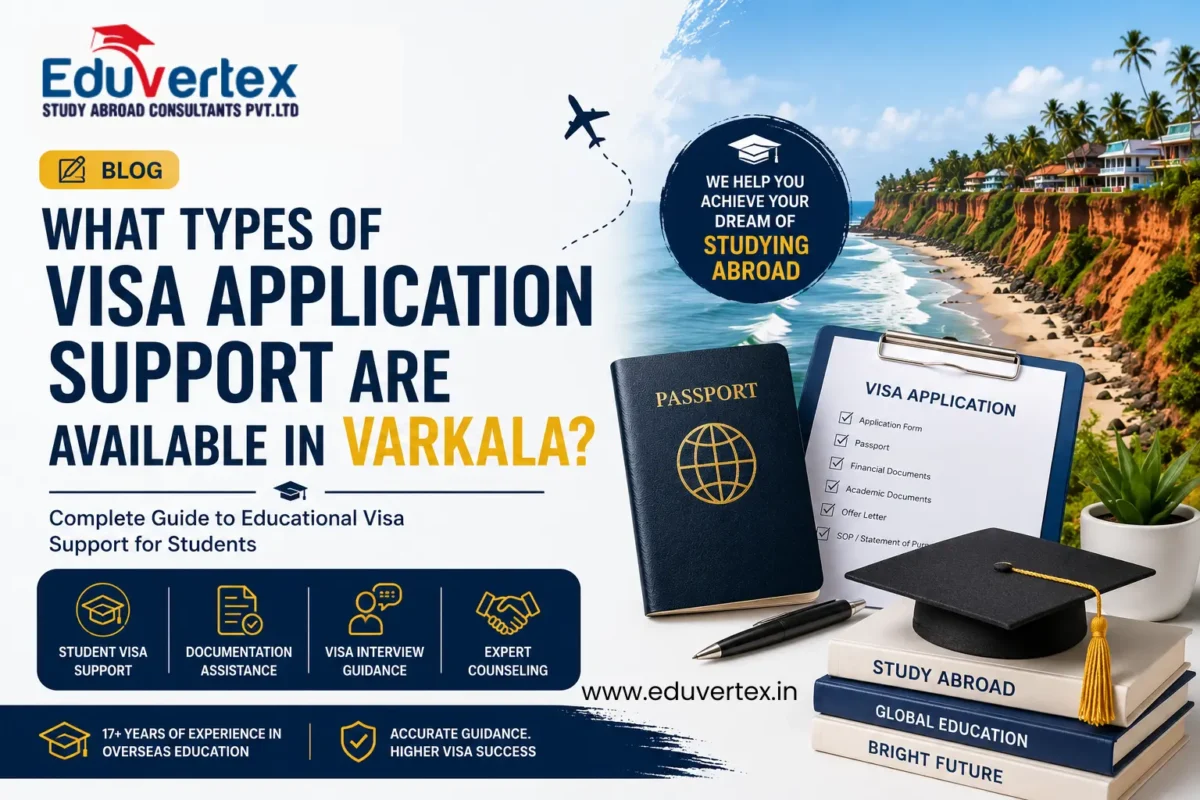
What Student Visa Application Support Is Available in Varkala?

Every year, hundreds of students from Varkala, Kollam, and Trivandrum take the biggest step of their academic lives — applying to study abroad. And every year, a significant number of those student visa application face delays or outright rejection — not because the students were unqualified, but because of documentation errors, unclear financial proof, or poor interview preparation.

At Eduvertex, our study abroad counseling team in Varkala has supported over 400 student visa applications in 2024 alone, with an 89% first-attempt approval rate for the UK, Canada, and Australia. The difference between approval and rejection almost always comes down to one thing: preparation. Knowing what each embassy expects, submitting a file that leaves no room for doubt, and walking into an interview with confidence.

This guide leads you through the full range of student visa application support offered in Varkala — what each service offers, the documentation you will need, the most typical rejection reasons, and how to choose a consultant who gives you an honest experience from day one.

Student Visa Application Support Available in Varkala

The demand for professional student visa application support in Varkala has grown significantly over the past five years as more Kerala students pursue undergraduate, postgraduate, and PhD opportunities abroad. Below is a full breakdown of every service component you should expect from a quality study abroad consultancy.

1. University and Course Selection Guidance

The visa process begins long before any form is filled. Choosing the right university and course is the foundation on which a strong visa application is built.

Our counselors guide students through:

  • Shortlisting universities based on academic profile, budget, career goals, and immigration outcomes — not agent commissions
  • Verifying that the institution holds the correct accreditation in the destination country (IRCC-recognized in Canada, UKVI-approved in the UK, CRICOS-registered in Australia)
  • Matching course selection to genuine career intent — a mismatch between your stated career goals and your chosen course is one of the leading SOP-related visa rejection triggers
  • Understanding post-study work rights and immigration pathways from each destination before you commit to an application

Students who choose their university with visa eligibility in mind have a significantly higher approval rate than those who apply to any institution that accepts them.

2. Document Verification and File Preparation

Once a university offer is secured, the document preparation stage begins. This is where most self-filing applicants make their most costly errors.

A thorough document review at Eduvertex covers:

  • Academic transcripts — Class 10, 12, and degree certificates are checked for accuracy, legibility, and completeness. Gaps in academic history must be explained
  • English proficiency scores — IELTS, PTE Academic, or TOEFL iBT results are verified against the institution’s minimum requirements. Borderline scores are flagged before submission
  • Offer letter review — conditional vs unconditional offers have different implications for visa timing and financial proof requirements
  • SOP alignment check — the Statement of Purpose is reviewed against the chosen course and university to ensure consistency. Counselors flag any narrative inconsistencies that an immigration officer would question
  • Cross-document consistency — every date, name spelling, and reference number across all documents must match. A date of birth entered differently on two forms is enough to trigger a refusal
3. Financial Documentation Preparation

Financial proof is the most common point of failure in student visa applications from India. Embassies do not just look at the balance figure — they examine the source, history, and stability of the funds.

Our team helps students prepare:

  • Bank statements that demonstrate consistent funds over the required period (typically 3–6 months depending on the country). A sudden large deposit without a documented source — salary, loan sanction, property sale — is a known and frequently cited rejection reason
  • Education loan documentation — the sanction letter, repayment schedule, and the bank’s authorization must all be in order. Many loan documents are accepted by the university but rejected by the visa authority if incorrectly formatted
  • Sponsor income proof — salary slips, ITR filings, Form 16, and business financials for parent or guardian sponsors must be current and consistent with the bank statement history
  • Scholarship documentation — if a scholarship is covering part of the tuition, the award letter must be from a recognized body and must clearly state the amount, duration, and conditions
4. Statement of Purpose (SOP) Guidance

The SOP is the single most personal and persuasive document in a student visa file. It is your opportunity to explain — in your own words — why you chose this course, this institution, and this country, and how it connects to your career plans.

A poorly written SOP is one of the most common reasons for rejection that applicants do not anticipate. Many assume that an acceptance letter from the university means the visa is a formality. It is not.

At Eduvertex, our counselors help students:

  • Structure the SOP to address every question an immigration officer is trained to ask: Why this course? Why this university? Why this country? What will you do after?
  • Ensure the SOP is consistent with every other document in the file — course choice, academic background, financial profile, and future career plans must align
  • Avoid generic, template-sounding language that visa officers recognize and discount
  • Review the final draft against country-specific SOP guidelines (UK and Australia have specific guidance on what should and should not appear in a student visa SOP)
5. Visa Interview Preparation

Not every country requires a visa interview — but for those that do, it is often the deciding factor.

Eduvertex conducts structured mock interview sessions that include:

  • Real visa officer question sets from current application cycles
  • Recorded practice sessions with feedback on both content and delivery
  • Specific preparation for course-related questions (interviewers often ask subject-specific questions to test genuine academic intent)
  • Guidance on documents to carry and how to present them during the interview
6. IELTS / PTE / TOEFL Guidance and Score Planning

English proficiency is a non-negotiable requirement for every major study abroad destination. But the score you need depends on your specific course, university, and country — and the gap between “accepted by the university” and “required by the visa authority” is a distinction many students miss.

Our counselors at Eduvertex help students:

  • Find the right minimal score for each the university and the visa application (they can differ)
  • Choose between IELTS Academic, PTE Academic, and TOEFL iBT based on the student’s profile and target institutions
  • Plan test timelines that allow for retakes if needed without delaying the visa application
  • Understand which scores are accepted by which visa categories (some UK courses accept PTE; some do not)
7. Visa Application Filing and Appointment Support

Once all documents are prepared, the visa application itself must be filed correctly — and the process differs significantly by country.

Our team handles:

  • Online application portal guidance — IRCC (Canada), UKVI (UK), ImmiAccount (Australia), and VFS/Embassy portals each have distinct requirements, document upload specifications, and common error points
  • Biometric enrollment — scheduling biometric appointments at VFS Global or BLS International centers and ensuring the timing works within the application window
  • Application fee guidance — current visa fees, payment methods accepted by each country’s portal, and what to do if a payment fails
  • Document checklist verification — a final pre-submission review to confirm every required document is present, correctly named, and in the right format before anything is submitted

Errors made during the application filing stage — a wrong date, an incorrect document uploaded to the wrong field, a missed biometric appointment — can result in automatic withdrawal of the application with no refund of visa fees.

Documents Required for a Student Visa Application

The exact document list varies by country, but these are the core documents required for almost every student visa application from India.

Personal Documents
  • Valid passport — minimum 6 months validity beyond your planned travel date, with at least 2 blank pages
  • Recent passport-size photographs — size and background specifications vary by country and must be followed exactly
  • Aadhaar card and PAN card copies
  • Police Clearance Certificate — required for long-stay student visas to several countries including Australia and Germany
Academic Documents
  • Original certificates and mark sheets — Class 10, Class 12, and bachelor’s degree (with all semester mark sheets if applying for a postgraduate course)
  • Offer letter or Conditional Offer letter from the university
  • English proficiency test scores — IELTS Academic, PTE Academic, or TOEFL iBT results with official score reports
  • Gap year explanation letter — if there is any academic break of 6 months or more, a written explanation is required
Financial Documents
  • Bank statements for the past 6 months — personal account, parent/sponsor account, or both
  • Education loan sanction letter — from a nationalized or recognized private bank, including the repayment schedule and the bank’s authorization letter
  • Sponsor income proof — salary slips (last 3–6 months), ITR filings for the past 2–3 years, Form 16, or business financials
  • Scholarship award letter — if applicable, from a recognized awarding body

Why Students from Varkala Choose Eduvertex for Study Abroad

Eduvertex has been guiding students from Varkala, Trivandrum, Kollam, and across South Kerala for over 17 years. Our focus has always been to study abroad — not a side service, but the core of what we do.

We do not push students toward universities based on commission agreements. We do not guarantee visa approval — because no honest consultant can. What we do offer is thorough preparation, an honest assessment of your profile and chances, and step-by-step support from your first counseling session through to your first week in your new country.

Frequently Asked Questions

1.What documents are necessary for a student visa application? 

The core documents for most student visa applications include a valid passport, academic transcripts (Class 10, 12, and degree), an offer letter from a recognized university, English proficiency scores (IELTS, PTE, or TOEFL), bank statements for the past 6 months, and a well-written Statement of Purpose. Additional requirements vary by country — Australia requires OSHC health insurance and may require a medical examination; Germany requires a blocked account of €11,208; Canada requires GIC enrollment. 

  1. How long does student visa processing take from India?

Processing times vary significantly by country and intake season. Canada’s Study Permit typically takes 8–12 weeks from the biometrics date. The UK Student Visa processes in 3–4 weeks for standard applications. Australia’s Student Visa (Subclass 500) averages 4–6 weeks, and Germany’s national student visa can take up to 12 weeks depending on the consulate’s workload. The USA F-1 visa typically processes within 2–6 weeks of the interview. Apply at least 3–5 months before your intake date — consulates in India face seasonal backlogs during the January and September intake rush.

  1. Does Eduvertex provide visa interview preparation for student visas?

Yes. Eduvertex provides structured visa interview preparation for USA (F-1), Canada (Study Permit), and UK (Student Visa) applications. Sessions include real visa officer question sets drawn from current application cycles, recorded mock interviews with detailed feedback, and specific coaching on course-related questions that test genuine academic intent. Students who complete our mock interview sessions consistently report higher confidence and significantly better outcomes.

  1. Why do student visa applications get rejected, and how can I avoid it?

The five most common rejection reasons from our counseling experience are: weak or unconvincing financial proof (especially sudden deposits without a clear source), an inconsistent or poorly written SOP, incomplete or mismatched documentation, poor visa interview performance, and choosing an institution not recognized by the destination country’s visa authority. Each of these is entirely preventable with proper preparation.

  1. Can Eduvertex help with education loans and scholarships for studying abroad?

Yes. As part of our overseas education counseling, we guide students through scholarship identification and application (merit-based, need-based, country-specific government scholarships, and university-funded awards) and help with the education loan process through nationalized and private banks. A properly documented scholarship or loan sanction letter also strengthens the financial proof component of your visa application — making it one process that serves two purposes.

Final Thoughts

A student visa application is one of the most consequential documents a young person from Kerala will ever submit. It determines whether the next chapter of your academic life begins on time, with confidence — or gets delayed by a preventable error.

Professional student visa application support in Varkala means more than help filling out forms. It means a counselor who knows what each embassy is looking for, who reviews your complete file before it is submitted, who prepares you to answer every question an immigration officer might ask, and who is honest with you about your chances before you spend money on application fees.

Book your free consultation today →

Categories
Blog

How Overseas Education Consultants in Trivandrum Help You Study Abroad?

Studying abroad is a life-changing decision—one that opens doors to world-class education, global exposure, and international career opportunities. However, the process of applying to foreign universities can feel overwhelming. From choosing the right country and course to managing documentation, finances, and visas, every step requires precision and expertise. This is where Overseas Education Consultants play a vital role.

For aspirants across Trivandrum and Kollam, professional guidance from experienced consultants can make the difference between confusion and clarity. At Eduvertex, the focus is on simplifying the entire overseas education journey while aligning it with long-term academic and career goals.

Understanding the Role of Overseas Education Consultants

Overseas Education Consultants act as strategic advisors, planners, and mentors throughout the study abroad process. Their role extends far beyond submitting applications. They evaluate academic backgrounds, understand individual goals, and map out realistic pathways to international education.

In regions like Trivandrum and Kollam, where global education aspirations are rapidly growing, consultants help bridge the gap between ambition and execution by offering structured, up-to-date, and country-specific guidance.

Personalized Study Abroad Counselling

One of the most valuable ways Overseas Education Consultants help is through personalized counselling. No two profiles are the same, and successful study abroad planning depends on understanding academic performance, language proficiency, financial readiness, and career direction.

At Eduvertex, counselling sessions focus on:

  • Identifying the right destination based on academic and professional goals
  • Matching profiles with suitable universities and programs
  • Clarifying eligibility criteria and realistic timelines

This personalized approach helps aspirants from Trivandrum and Kollam make informed decisions instead of relying on generic advice.

Country and Course Selection Made Simple

With countless universities across the UK, Australia, Germany, Ireland, France, Canada, and other destinations, selecting the right country and course can be confusing. Overseas Education Consultants bring clarity by analysing global education trends, employment prospects, and post-study opportunities.

Rather than choosing a destination based only on popularity, consultants help align:

  • Course relevance with future career plans
  • University reputation with budget considerations
  • Country selection with post-study work and migration options

This structured guidance ensures long-term value from an overseas education investment.

University Shortlisting and Application Strategy

Applying to international universities involves more than filling out forms. A strong application requires strategic planning, accurate documentation, and timely submissions. Overseas Education Consultants help design a step-by-step application roadmap.

Support typically includes:

  • Shortlisting universities based on profile strength
  • Understanding intake deadlines and admission cycles
  • Assisting with application documentation
  • Ensuring accuracy and completeness

For aspirants in Trivandrum and Kollam, this structured process reduces stress and improves admission success rates.

SOP, LOR, and Documentation Support

Statements of Purpose (SOPs) and Letters of Recommendation (LORs) are critical components of international applications. Many applicants struggle to present their goals clearly and convincingly.

Experienced Overseas Education Consultants guide applicants in:

  • Structuring SOPs that reflect academic intent and career vision
  • Aligning content with university and visa expectations
  • Reviewing and refining documentation for clarity and impact

This guidance ensures that applications stand out while remaining authentic and compliant.

Scholarship and Financial Guidance

Financing overseas education is a major concern for many families. Overseas Education Consultants provide clarity by helping explore scholarships, tuition waivers, and financial planning options.

Consultants assist with:

  • Identifying country- and university-specific scholarships
  • Understanding proof-of-funds requirements
  • Planning expenses realistically

For aspirants from Kollam and Trivandrum, this financial transparency helps avoid last-minute hurdles and unexpected costs.

Visa Application Assistance and Compliance

A strong admission offer is only half the journey—the visa stage is equally crucial. Each country follows strict visa regulations, and even small errors can lead to delays or rejections.

Overseas Education Consultants ensure:

  • Accurate visa documentation preparation
  • Financial and academic compliance
  • SOP alignment with visa requirements
  • Interview preparation where applicable

With professional visa guidance, applicants move forward with confidence and clarity.

IELTS and Language Test Guidance

Language proficiency tests like IELTS play a key role in overseas admissions. Consultants guide applicants on:

  • Required band scores for different destinations
  • Test preparation strategies
  • Retake planning if needed

This ensures applicants from Trivandrum and Kollam meet university and visa language requirements without unnecessary delays.

Pre-Departure Support and Beyond

The role of Overseas Education Consultants does not end with visa approval. Pre-departure guidance helps aspirants prepare for life abroad, including:

  • Accommodation planning
  • Travel and documentation checklists
  • Understanding academic culture and expectations

This holistic approach ensures a smooth transition into international education systems.

Why Choose Overseas Education Consultants in Trivandrum and Kollam?

Local expertise combined with global knowledge makes a significant difference. Consultants familiar with the aspirations and challenges of aspirants in Trivandrum and Kollam offer culturally aware, realistic, and goal-oriented guidance.

Eduvertex focuses on:

  • Ethical counselling and transparent processes
  • Destination-specific expertise
  • Personalized attention at every stage

This approach builds trust and long-term success.

The Eduvertex Advantage

At Eduvertex, the goal is not just admissions—it’s long-term success. With a structured, student-focused approach, Eduvertex supports overseas education journeys from the first counselling session to final departure and beyond.

By combining global insights with local understanding, Eduvertex has positioned itself as a trusted name among Overseas Education Consultants serving Trivandrum and Kollam.

Studying abroad is a transformative experience—but only when guided correctly. With expert support from experienced Overseas Education Consultants, the complex process becomes clear, manageable, and rewarding.

For aspirants in Trivandrum and Kollam, professional guidance ensures smarter decisions, stronger applications, and smoother transitions to global education opportunities. With the right roadmap and expert support, studying abroad becomes not just a dream—but a well-planned reality.